Jefferson Airplane in Five Designs: White Rabbit, Volunteers and the San Francisco Sound
On 13 August 1965, a folk singer named Marty Balin opened a club in San Francisco called the Matrix. The band on stage that first night was his own new group, playing its first public show as Jefferson Airplane. Within two years they had two Billboard hits, and they went on to become the first band from the Bay Area to find international commercial success.
If you have ever wondered why that name still turns up on hoodies and tees almost sixty years later, the clearest way in is through the artwork. Five Jefferson Airplane designs each point to a different chapter of the band's story. Here is what each one shows, the history behind it, and who it might suit.
Where did a name like Jefferson Airplane come from?
It started as a joke. Guitarist Jorma Kaukonen had a nickname, "Blind Thomas Jefferson Airplane", given to him by his friend Richmond "Steve" Talbot as a riff on the bluesman Blind Lemon Jefferson. When the new band needed a name, Kaukonen suggested it, describing it as something "really silly". It stuck.
The early lineup was Balin, Paul Kantner, Kaukonen, Signe Anderson, Skip Spence and bassist Bob Harvey, who was soon replaced by Jack Casady. Their first studio album, Jefferson Airplane Takes Off, arrived in 1966.
That first record is the subject of the Takes Off Anniversary design: a round emblem with an orange airplane, the words Fiftieth Anniversary and a big 50. It is a quiet, neat piece, a good pick for someone who likes to start any band at the beginning.
Why is "White Rabbit" still the song everyone knows?
In 1966 Grace Slick joined, replacing Signe Anderson, and she brought two songs from her earlier band, the Great Society. One was "Somebody to Love", written by her brother-in-law Darby Slick. The other was her own "White Rabbit". On the Billboard singles chart, "Somebody to Love" reached No. 5 and "White Rabbit" No. 8, and both appeared on Surrealistic Pillow (1967), the band's second album.
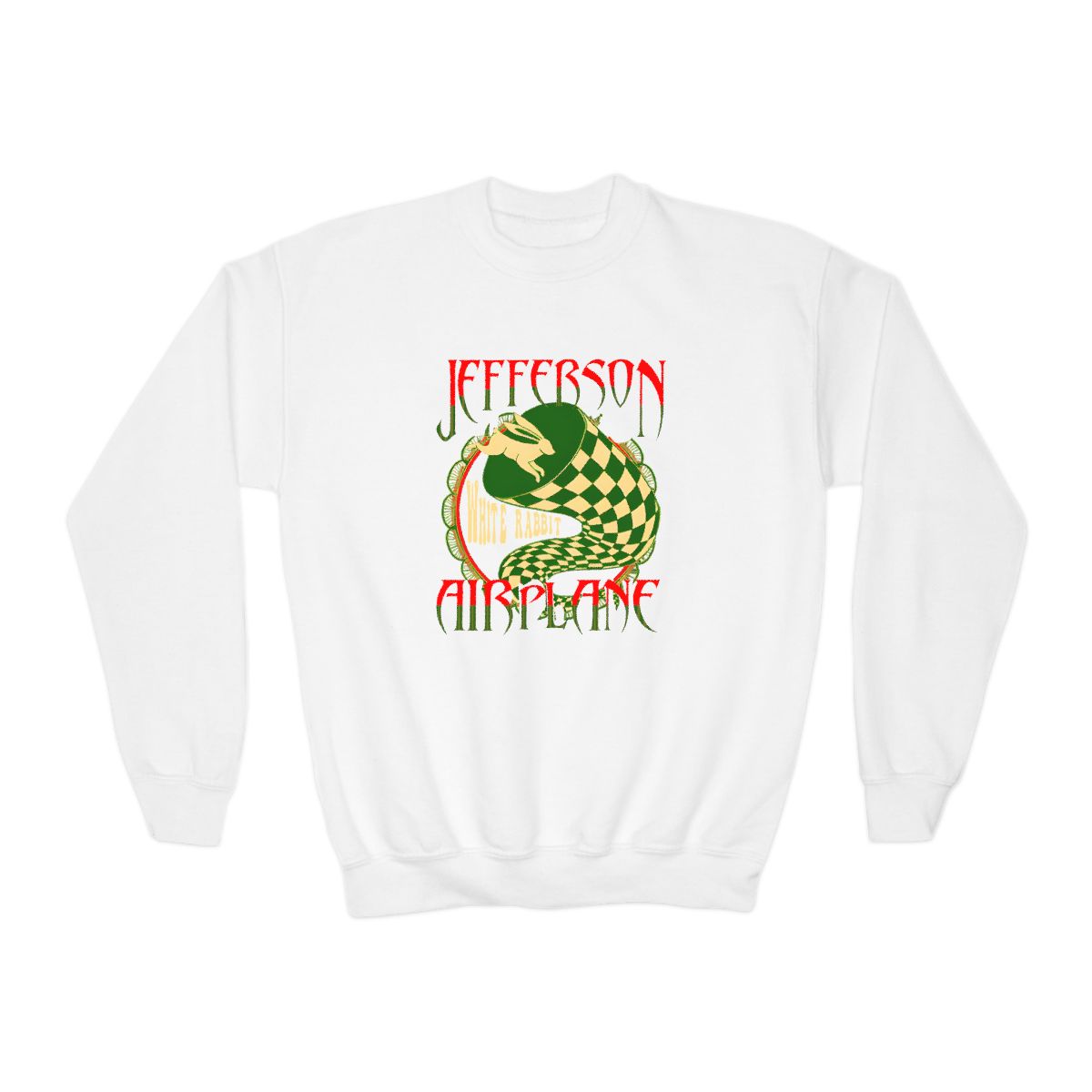
The White Rabbit design takes the song's title literally: a rabbit leaps over a twisting green checkerboard tunnel, with the band's name in tall red letters. It is bright, a little dizzy and instantly readable, which makes the White Rabbit youth crewneck sweatshirt an easy gift for a younger listener who has just found the song through a parent's record collection.
Grace Slick has her own piece too. The Grace Slick Lettering design spells out her name in swirling blue outline letters with a solid shadow: a simple tribute to the voice behind both hits.
What was the San Francisco Sound?
Jefferson Airplane are described as the band that defined the San Francisco Sound: psychedelic rock with roots in folk, sometimes called acid rock. The city is part of the band's identity, and the SF 1965 Winged Guitar design leans into it. A winged guitar sits in front of the Golden Gate Bridge, two airplanes fly past, and the words SF.CA 1965 mark the year it all began.
If you want the whole era in one picture, this is the one. It works for anyone with a soft spot for San Francisco, whether or not they could name a single album.
For the full poster-shop mood, three more designs go further into colour:
- Psychedelic Logo: the band's name in curling letters filled green to blue, outlined in hot pink with a black shadow.
- Flower Frame Poster: a group photo in green, orange and pink under swirl lettering, framed in pink flowers.
- Peace Ring: a group photo inside a ring of stars and peace symbols.
Why does Volunteers matter so much?
By 1969 the classic lineup was Balin, Kantner, Slick, Kaukonen, Casady and drummer Spencer Dryden. That year brought Volunteers, their fifth studio album, and two of the most famous festivals in rock history. They played Woodstock in August 1969, in the early-morning slot Grace Slick called "morning maniac music", and Altamont that December. Add the Monterey festival and Jefferson Airplane are described as the only band to play all three.
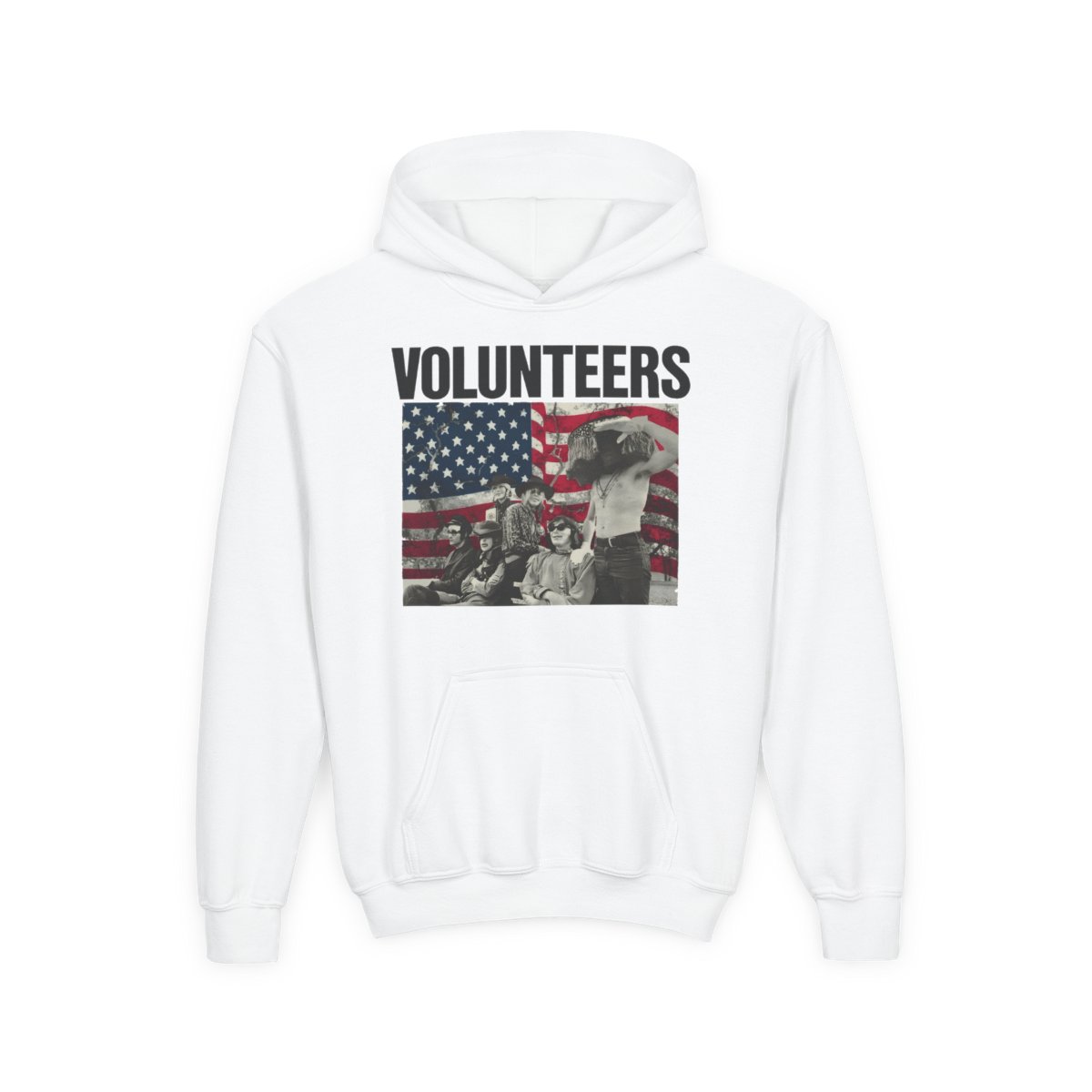
The Volunteers design is the heaviest of the set: VOLUNTEERS in thick black capitals over a black-and-white band photo and a cracked flag. It has the weight of that year without saying a word about it. On the Volunteers youth hooded sweatshirt it becomes a cold-weather piece for a teenager who likes their music with some history attached; the same design also comes on crewnecks and a long sleeve tee.
How was the story recognised later?
The original run closed with the live album Thirty Seconds Over Winterland in 1973. Several members went on to Hot Tuna and Jefferson Starship, and several classic members came back together in 1989 for an album called Jefferson Airplane and a tour.
The honours came steadily after that:
- 1996: the 1966 to 1970 lineup entered the Rock and Roll Hall of Fame.
- 2016: a Grammy Lifetime Achievement Award.
- 2022: a star on the Hollywood Walk of Fame.
That is a long reach for a band named after a joke at a friend's expense.
Which design should you choose?
A short way to decide:
- For the beginning of the story: Takes Off Anniversary.
- For the song everyone hums: White Rabbit.
- For a love of San Francisco: SF 1965 Winged Guitar.
- For colour and flowers: Psychedelic Logo, Flower Frame Poster or Peace Ring.
- For 1969 and the festivals: Volunteers.
- For the voice: Grace Slick Lettering.
Most of these designs come on kids' tees, youth hoodies and youth crewnecks, so the band's story is easy to pass down to the next listener in the family. Pick the chapter that means the most to the person you have in mind, and the artwork does the rest.